









Imagine a day when the crops planted by the farmer down the road aren’t grown to supply food, but to produce electricity. This scenario is still largely unimaginable in the United States, but it’s been a reality for more than a decade in Europe, where new technology provides both a growing source of clean, renewable energy and financial stability to family farmers.
The energy is called biogas, and it’s based on the principals of decomposition and fermentation. Biogas systems, also called methane digesters, transform organic materials such as manure, crops, or food waste into methane, a fuel much like natural gas. Methane can be used to generate electricity and provide heat, and even a moderately sized biogas system can create enough electricity to pay for itself relatively quickly by selling power back to the grid.
In Germany, Austria, and Italy, it’s estimated that more than 4,000 biogas systems are in operation on farms of various sizes, mini-power plants that produce electricity around the clock. Some farmers who once ran dairy operations have even sold off their milk cows and now produce crops expressly for the purpose of making electricity.
For five days in early June, a ten-person delegation from upstate New York and Vermont visited six farms in Austria, which is a European leader in renewable energy. The trip was organized by MWK Biogas North America Corp., the US affiliate of a German designer of state-of-the-art biogas systems. In Europe, MWK and its subsidiaries boast annual sales of between 80- and 100-million Euros annually. The Americans’ aim was to observe how this cutting-edge technology is being applied to create efficient and cost-effective green energy systems, and consider how that technology can be imported to the US.
“I had to go to Austria to see how prehistoric the United States is,” says Albert Floyd, a community leader who owns the general store in Randolph Center, Vermont. Like others on the trip, he returned amazed by the widespread and sophisticated applications of all types of alternative energy technology in Austria, and by its beautiful farms and pristine countryside, untouched by suburbia. “This country is run by the oil and automobile industries,” Floyd says of the US. “We have our heads in the sand.”
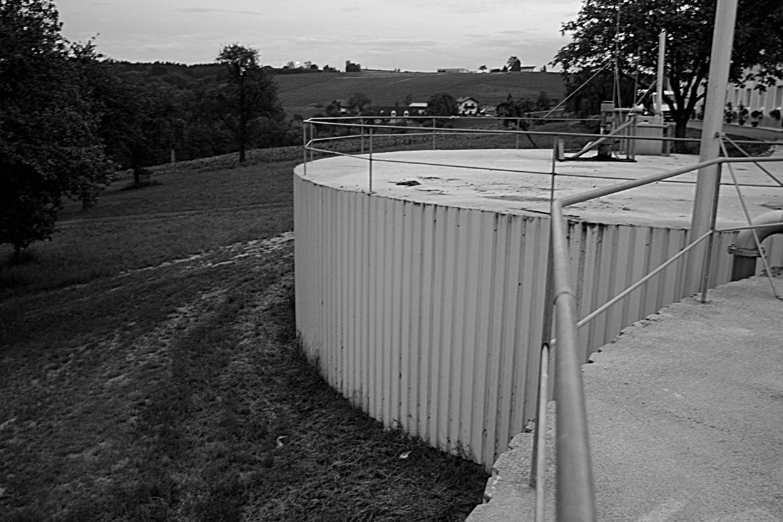
The object of the delegation’s scrutiny was the newest generation of methane digesters designed by MWK. These biogas systems are comprised of a series of two to six interconnected, sealed tanks that break down organic materials in the absence of air. The technology mimics the process that takes place inside the four chambers of a cow’s stomach. Cows and other ruminants, such as sheep and goats, are able to break down the cellulose in grass and other plants to produce nutrients. In nature, methane is a by-product of the process, as anyone who’s stood near a gassy cow knows. In the biogas business, that gaseous substance is the end product.
According to those who have seen biogas systems at work, methane digesters are clean and durable, and emit only an inoffensive, earthy odor. The methane is stored and used like natural gas as a fuel to create electricity. Co-generated heat, which accounts for half the energy embodied in methane, is captured to heat buildings or water, or for other purposes. The solid by-product of the process can be sold as organic fertilizer. Biogas systems use big bladders to store methane, preventing its release into the atmosphere. Methane is 23 times more potent than carbon dioxide as a greenhouse gas, and some farmers are able to gain compensation for preventing the release of methane through biogas production, which is carbon-neutral.
Sylke Chesterfield of Rensselaer, New York, organized the tour. Chesterfield describes herself as an “affiliated agent” for MWK. Her introduction to the firm was fortuitous. In 2004, Chesterfield, who was born and raised in Germany and had been self-employed in business consulting and public policy for more than a decade, decided to try her hand as a translator. Her first client was a group of US businesspeople who were pursuing a partnership with MWK’s chief designer and CEO, Matthais Wackerbauer. The original business deal fell through, but Chesterfield, convinced of the brilliance of Wackerbauer’s biogas designs, continued to work with him to introduce his technology into the North American market.
Chesterfield brings the boundless enthusiasm of a convert to her position as so-called “chief bottlewasher” for the American venture. “It was the first time I could be passionate about something,” she says, allowing that she couldn’t find any “down side” to Wackerbauer’s systems to check her interest. With no official title and, as of June, no contract, Chesterfield has worked from her Rensselaer home to facilitate MWK’s North American start-up for a year, “based on my conviction,” she says, “that the technology is the best thing since sliced bread, and that the projects in development will actually come to fruition.”
The projects she’s referring to are the first two MWK biogas systems to be built in the US. Participating in the recent Austrian fieldtrip were two Vermont farmers poised to start construction of advanced methane digesters later this year. With power capacities rated as 630 kilowatts and 1.9 megawatts, these systems will produce more electricity than the few on-farm methane digesters currently in operation in the region.
After three decades of refinement, European biogas systems are considerably more advanced than those in this country. Methane digesters in the US can be characterized as first-generation systems. They consist of a single tank instead of multiple ones, giving the operator little latitude for adjusting the liquid mixture for acidity, moisture content, and other parameters to boost methane production. So-called plug flow digesters, the most common design for manure systems here, lack a mixing propeller and cannot accommodate other raw materials. With their short processing time—about twenty-one days, compared to two to four months in the MWK system—less of the carbon in the organic material breaks down, resulting in reduced methane production.
Farmers here frequently have built digesters without benefit of an engineer, and their systems suffer from poor performance. In contrast, MWK provides rigorous planning to match system design to the types and quantities of raw materials to be used, and designs its systems to be long lasting and easily maintained. The digesters are computer-controlled with proprietary software that allows farmers to monitor fermentation reactions as they occur. One farmer likened such technical support to the dairy nutritionist who visits weekly to balance the herd’s rations for optimal milk production.
In the Northeast, methane digesters have been deemed too costly for all but the largest dairy farms, typically those in the 1,000-cow range. Here, the overriding purpose of digesters is manure management; they’re used primarily to reduce noxious odors and help the farmer control pollution from excess nitrogen and other nutrients.
Producing electricity takes a back seat to such objectives. Despite generous subsidies, only about 10 New York dairy farms have built methane digester systems that generate and sell power to the electric company. Likewise, the “Cow Power” program, sponsored by Central Vermont Public Service, counts just four or five farms selling electricity from manure-based methane. According to Tom Fiesinger of the New York State Energy Development Authority, methane digesters cannot pay for themselves through power production. The more sophisticated European systems, however, claim a relatively quick payback on investment.
“A wonderful new cash crop for farms,” is how Robert Ide, director of Energy Efficiency at the Vermont Department of Public Service, sees biogas operations. Ide is convinced that growing crops for electricity is a good fit in Vermont, and thinks it makes sense especially on land that has been protected from development but isn’t being farmed. One acre of farmland can produce enough raw material to continuously generate a kilowatt of electricity throughout the year, or more than 8,000 kilowatt hours, according to MWK’s Chesterfield. When methane is burned in an efficient generator, about 38 percent of its embodied energy is turned into electricity, and another 45- to 50-percent is released as usable heat.
The Austrian trip turned many of the delegates into believers in the potential of biogas to create both sustainable energy and prosperity for farmers. For some who took the tour, the happy farmer whose new Mercedes replaced his old Opal was emblematic of the returns accruing to those who invest in biogas systems. The idea of growing crops for electricity came to Alburg, Vermont, farmer Guy Palardy by way of his sister, who works for the Vermont Agency on Agriculture. After learning that farmers in other countries were farming biogas, Palardy recalled, “She sat down at my kitchen table and told me, ‘This will change your life.’”
In 2005, back problems caused him to quit milking and sell his cows, but Palardy had no intention of leaving farming. His 800-acre spread in the far north of the state had been more than ample for his 120-cow dairy operation, and he had developed a good feed business as well, supplying farmers and dealers. Selling electricity from the farm—a real home-based business—appealed to him as an alternative to delivering feed, with its ever-rising fuel, vehicle, and employee costs. Just back from his second biogas-research trip to Austria, the 52-year-old farmer said the system he will break ground for this summer has grown to 1.9 megawatts, almost 10 times bigger than his initial concept.
Palardy could not get credit in the US for the $8.9 million project, but was able to secure a loan from a German bank, which more fully understood the concept of his proposal. He was reticent about the anticipated income from his biogas enterprise, but company projections show a payback time of just seven years for his multimillion-dollar investment. In addition to the sales of electricity, Palardy says the operation will generate income through sales of organic fertilizer, a byproduct of the digestion process, and by using the heat produced by the methane to manufacture solid-fuel wood pellets.
From his extensive acreage, Palardy can supply 15,000 tons of organic material a year, slightly more than half the huge amount of raw materials his biogas digester will require. He has contracted with several neighboring farmers to sell him surplus crops. Palardy estimates that the feed bunkers necessary to store the material will take up an acre of land; he calls these bunkers—essentially open silos—his “sun bank,” alluding to the solar energy contained in the crops that the process will release. Another important source of raw material will be food-processing waste and rejected food products, which would otherwise be landfilled or composted. One supplier of this waste is willing to pay Palardy a tipping fee to take the material from him.
The displacement of food and feed crops by fuel crops has become a major criticism of certain biofuels, including corn-based ethanol and biodiesel from oil-seed crops like canola and sunflowers. Intense competition between ethanol plants and other end users, including food producers and dairy and livestock farmers, resulted in the recent doubling of corn prices. An advantage of biogas is that it can be produced efficiently from all kinds of crop plants rather than just corn. Corn consumes considerable energy by way of its high fertilizer needs and is responsible for a great deal of soil loss from erosion.
In Vermont and upstate New York, erratic prices for milk have resulted in a sharp decrease of active farms over the past two decades. Untended farmland, without annual mowing, soon becomes young forest, or, worse, with increasing development pressure, succumbs to suburban sprawl. Not only could biogas contribute to our ever-growing demand for electricity, in a region known for its agricultural character it might also preserve the rural landscape and the farming way of life.



This article appears in August 2007.


